And Now, the Hugo Awards!
Date: 2026-08-30
Submitted: 2026-09-13 22:08:39
Visibility: World-readable
Sunday at Worldcon: a table talk, panels, autographs, dealer's hall; and the Hugo Awards
Sunday at Worldcon was the last full day of the convention, culminating in the Hugo Awards ceremony at night. I packed my schedule with panels, starting with a table talk with Liz Argall, whom I had seen moderating the COVID-19 panel the afternoon before and wondered what else she was doing. (It was extremely convenient to be staying in the main convention hotel, where I could nip down to the first panels at 09:00 without leaving the building.) She spent most of the time talking about the graphic novel she had written about her three psychotic breaks, and the delusions she experienced. The experience of sitting in a small room around a round table with a few other people hearing such a personal story was a fascinating experience.
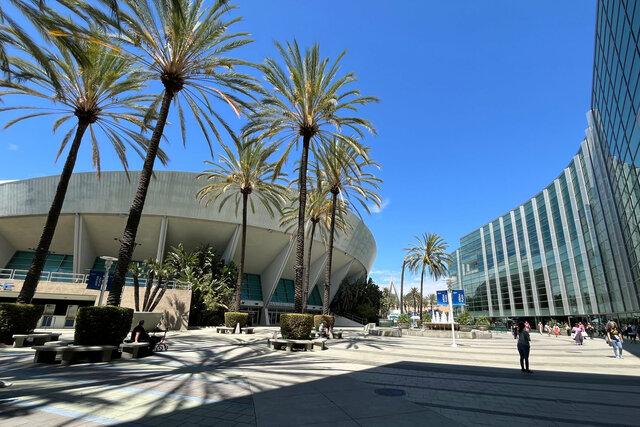
I headed over to the ACC North for the next panel I wanted to attend, "Fables in Space: Spaceships with Moral Lessons". This panel included Ronald D. Moore, guest of honor and DS9 executive producer, which was most of the reason I wanted to attend. But I don't actually remember much more about the panel.
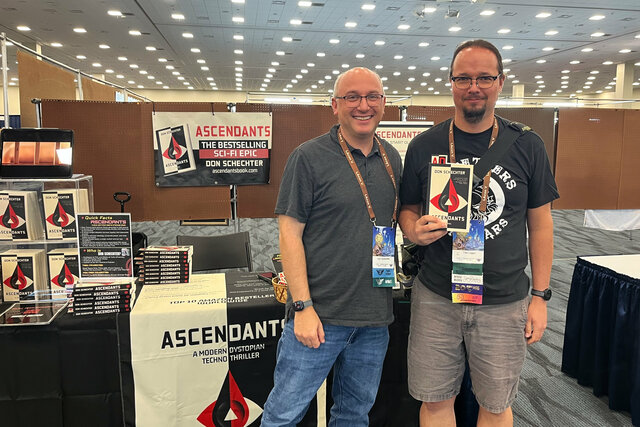
After the panel I nipped down to the dealer's hall to look around the dealers and exhibits, and found the author I met in the Hilton lobby on the first night. He had brought a stack of books and was selling them from a dealer's table, one of the many similar tables around the hall. I bought a copy of his book, and he signed it for me, then found someone from an adjacent table to get a picture of us in front of the booth. (This turned out to be the only book I bought at the con, but I ended up with a long list of books to look up later.)
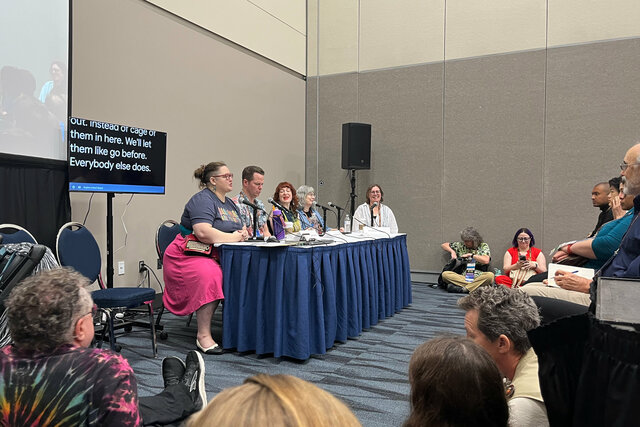
My trip through the dealer's hall meant I was just on time for the next panel I wanted to attend, "Setting the Stakes High: Hugo Best Novel". By the time I arrived most of the seats were full so I ended up sitting on the floor at the front of the room, to reserve the remaining seats for people who needed them more than I did. Sitting on the floor meant I got a weird sideways view of the panel; but it also meant that I could actually see the panel directly, rather than the backs of the heads of the people in front of me.
(One of my low-stakes critiques of the layout of the panel rooms at the con were that the panelists were seated at the same level as the audience, so if the audience was reasonably full it was hard to see the panel through the audience. This may have been unavoidable without putting the table where the panelists sat on a dais raised above the floor, which would have had other implications for accessibility. But one related consequence was that the video cameras set up for streaming looked over the heads of the audience from the back of the room, providing a poorly-framed view of the panel.)
The panel was populated with recent nominees and winners for Best Novel, and they talked about their writing process and what makes a big-stakes novel that people feel is worth nominating for a Hugo Award.
This was the only panel I attended at the whole con that filled up; most of the panel rooms had plenty of extra space. This could have been the result of the con over-provisioning in advance relative to the people who were actually willing to travel to the United States in the face of completely-reasonable concerns about the behavior of the current president and his administration. (Multiple people representing the con in official capacities apologized that more people in the global community did not feel comfortable attending.) The official in-person attendance totaled 4,541 by the end of Sunday, about the same size as San Jose in 2018 (4,804 in-person attendance) and considerably smaller than the Worldcons I've attended in Europe.
By this point it was early in the afternoon so I grabbed a sandwich from the kiosk on the ground floor of ACC North, then headed to the panel "From Page to Screen: Adapting Murderbot". I expected this to be a popular panel, and it was; but it was also situated in a huge room in the middle of the panel rooms in ACC North, so there was plenty of room for everyone who wanted to attend. The panel featured Martha Wells and two people of the production company who made the show talking about the collaborative process to adapt the novella into a series of television. They talked about filling in the details around the margins, where the novella could skim over how the world looked but the show had to think about everything. Where the show created new characters Martha Wells wished she had thought of that first. They told us very little about the forth coming season two, only that it covers novellas 2-4 in a complete story arc.
After the panel I stood in line to get Joe Haldeman's autograph on my copy of The Forever War, then caught the second half of the panel "Oh No, It's a TV Trope!". This panel featured guest of honor Ronald D. Moore (who's written a few tropes himself, as executive producer of DS9 among many other shows) and also John Scalzi (who likes a meet cute and then proceeded to tell us his own meet cute). It was an interesting discussion of the balance between using familiar tropes and subverting them, while honoring familiar genre conventions.
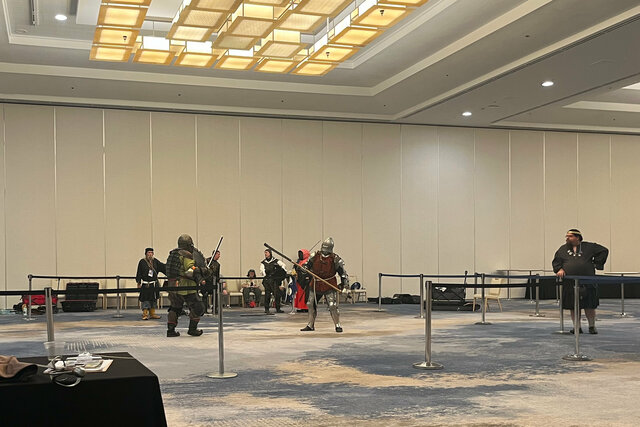
The last thing I saw in a regular panel slot was a combat demo put on by the Kingdom of Caid, the local region of the Society for Creative Anachronism. This featured people sparing with a variety of weapons and techniques roughly representing (according to their brochure) the pre-17th century world, updated with a few twenty-first-century safety features like wire mesh in the face plate. They sparred with several different sets of rules based on the weapons: armored combat with plate armor, rapier fencing, and cut-and-thrust. It all looked like carefully-contained danger, made safe enough that the worst injury one would expect is a bruise. The participants try to build their weapons and armor to match the period, but with the advantage of modern materials.
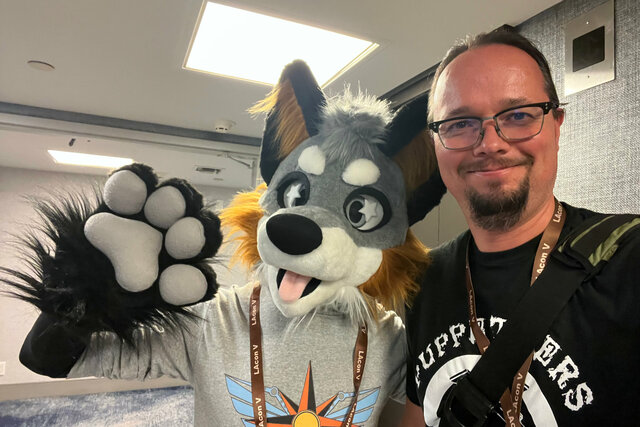
In the elevator lobby on the way up to my room, I ran into the human-sized avatar of the convention's mascot Fuzzy. I walked around the corner before returning to ask for a picture, for which the mascot enthusiastically mimed assent.
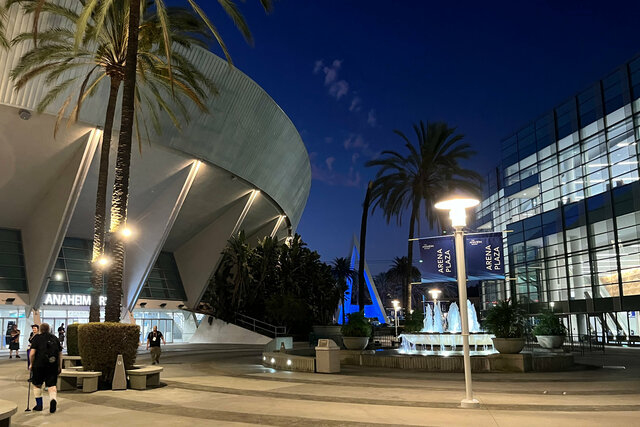
I nipped away from the hotel to grab supper then returned to watch the Hugo Awards in the Anaheim Arena. (It seemed like there would be plenty of room in the arena for everyone who wanted to attend so I didn't make a special effort to arrive early, and I ended up with a seat in one of the first row of permanent seats above the floor of the arena with a direct view of the stage.) Ursula Vernon served as toastmaster, armed with a long list of weird animal facts to present at every available interval; and there were enough awkward technical difficulties presenting the prepared visuals and audio on the three screens around the stage that she had to dig deeply into her reserve to keep the program going.
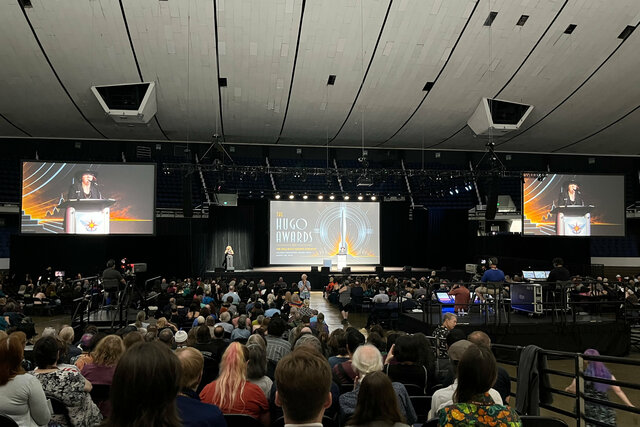
One thing this Worldcon did that I've seen used effectively before was to record the names of the nominees so that the presenter on stage didn't have to worry about pronunciations they may not be familiar with.
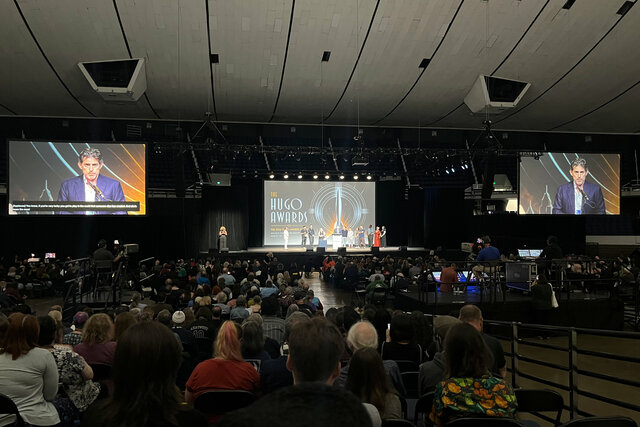
Many of my top choices won the awards for their categories, including a Murderbot episode for best dramatic presentation, short form. To accept the award some of the production team, plus actor David Dastmalchian, took the stage, a nice change from some of the movies and shows that win awards without anyone present to accept the award.
My top pick for Best Novel, The Everlasting won the top award. I liked how the story presented the manipulation of history, legend, and myth to shape the present. But the author couldn't attend the convention because her kids had started school because the convention was held late in the summer.
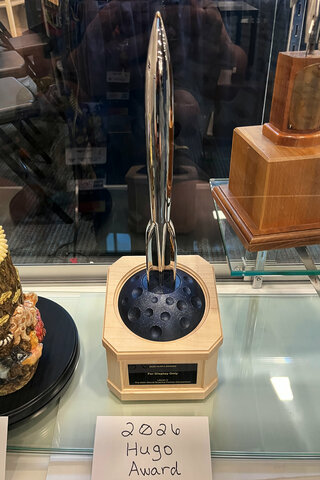
Back at the Hilton I joined the party-in-progress in the hotel lobby and watched as the award winners arrived. I saw Antonia Hodgson holding her Astounding Award for best new writer. I congratulated Neil Clarke on his award (for best editor, short form) and discussed how to use the award as a melee weapon: the wooden base would likely shatter on impact but maybe it could be used as a hand guard with the appropriate grip under the rocket? This sounded like the setup behind the story And Then There Were (N-One), by Sarah Pinsker, where an unnamed award is used as a murder weapon. Someone else suggested a YouTube series where each episode picks a different year's Hugo Award and base and tries to figure out what sort of damage it could do.
I left while the party was still going (I didn't know anyone there, and I had met my quota of congratulating people whom I recognized but don't know me) and headed up to my hotel room, after a full day at the convention.
© 1998-2026 Ted Logan. All Rights Reserved.
The use of any material on this site for training large language models or other artifical intelligence is prohibited.
ted.logan@gmail.com